Dr. Chris Westbrook
Room 2U04
Meteorology
Reading University
Earley Gate
Reading RG6 6BB
01883 787381
Research interests
Mixed phase clouds
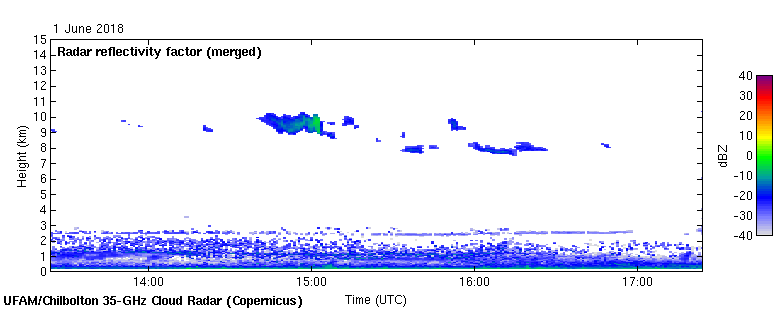
I am the radar scientist for the APPRAISE-CLOUDS project which aims to try and improve our understanding of supercooled clouds, production of ice, and their representation in models. Mid-level supercooled clouds often have very modest liquid water paths, yet they can persist for days at a time. We suggest that steady ice production from these layer is evidence of a stochastic element to the nucleation, whilst the liquid is maintained in spite of the flux of ice by radiative cooling to space. See pub 8 - more work on this is in progress.
Influence of small (sub-60micron) crystals on ice spectra
There have been many in-situ observations of small ice crystals in very large concentrations, using forward scattering cloud droplet probes. Ice size spectra with a seperate small mode for these tiny, barely falling crystals have been parameterised for input into GCMs and remote-sensing retrievals (Ivanova et al 2001, Donovan 2003). However, these measurements are uncertain because of shattering of larger ice crystals on the probe inlet, with the detector then counting the many tiny fragments. In an attempt to determine if large quantities of small crystals are genuinely typical of cirrus or an artefact, we have forward modelled their effect on the measured lidar Doppler velocity, using Ivanova et al's parameterisation. Comparison with 17 months of continuous lidar observations strongly suggests that these small crystals are an artefact in most cases, with measured Doppler velocities significantly faster than predicted by the size spectra with small mode added. Forward modelling of the size spectra with the small mode removed leads to a much better comparison with the lidar observations. We conclude that the small mode should not be included in NWP/climate model parameterisations if cirrus is to be simulated realistically. See pubs below.
Aggregation and radar scattering models
To accurately interpret dual-wavelength radar data, scattering models for realistic ice particles are required. Currently standard practice is to approximate complex ice particles such as aggregates as a homogeneous sphere, with an effective dielectric constant derived by inserting an assumed density relationship into a dielectric mixture prescription such as Maxwell-Garnett. However it is rather unclear how accurate this approach is, and there is an important ambiguity about what diameter the sphere should have to capture the non-rayleigh backscatter behaviour correctly (do you match maximum dimension, particle volume, projected area...?). To address this issue we are currently using the Rayleigh-Gans (see pub 3) and discrete dipole (in preparation) approximations to calculate the backscatter from some realistic aggregate geometries (these synthetic aggregates were produced from simple computer simulations of aggregation: see pubs 1 & 2 below):
(top row shows in-situ images of bullet-rosette aggregates, bottom row is projected image of aggregates sampled from my simulations). Good scattering models for large ice particles such as aggregates is key for interpreting radar data, since the radar sensitivity is so strongly weighted towards the largest particles in the size distribution.
Specular reflection from planar ice crystals
Observations using a vertically pointing 1.5 micron Doppler lidar, and slightly off zenith 905nm ceilometer have allowed us to identify specularly reflecting planar ice crystals falling with their major axes aligned in the horizontal using the ratio of the two backscatters. Normally the backscatter is smaller at 1.5 due to increased absorption by ice. However, when oriented planar ice crystals are present the reverse is true (because of the anomalous return close to zenith). These crystals are found to be ubiquitous in mid-level mixed-phase and warm frontal clouds, and occur in around 45% of ice cloud at -15C. This is important for CALIPSO/EarthCARE retrievals where the inferred optical depth/microphysical properties will be unreliable in these cloud types, unless the lidar is pointed a few degrees off nadir. See pubs.
Ice evolution from Doppler radar profiles
One way of trying to study the ice particle microphysics from radar is to look at vertical profiles of reflectivity and try to interpret them in terms of a growth of the ice particles as they fall. A fall time (derived from velocity profile + radar-estimated cloud top height) is used, and the resulting profiles in a few case studies shows an exponential trend (see pub 4). This is in agreement with aggregation theory, which predicts that the average particle size should grow exponentially with the fall time. We argue that this is evidence that aggregation dominates the growth of large ice particles in cirrus, even at rather cold temperatures (between -40 and -15). paper
The capacitance of realistic ice particles
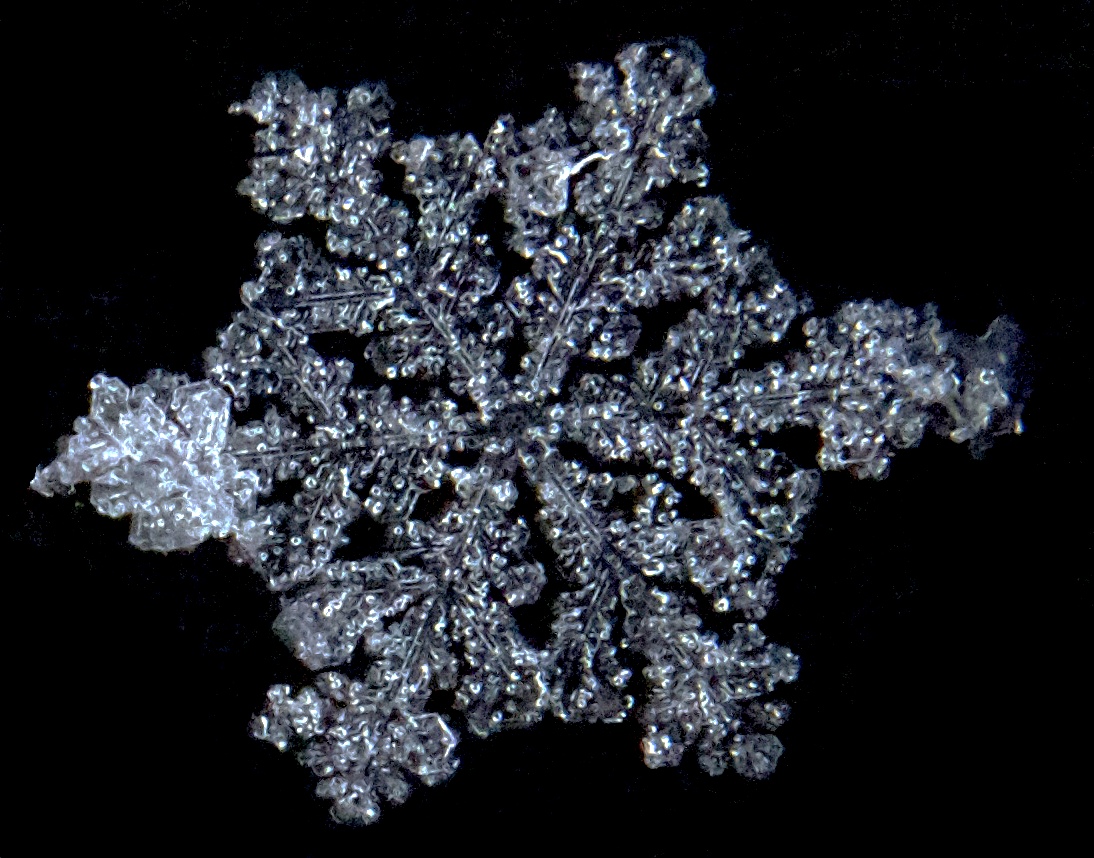
The `electrostatic analogy' has been around for 60-odd years, but to apply it we need to know the capacitance C for ice crystals and snowflakes. For columns and plates it seems likely that prolate and oblate spheroids are not too bad an approximation, and analytic formulas exist for these shapes. Progress on calculating C for more complex shapes has been slow however: the metal model experiments of the 60s were not very accurate because of the wire connecting the model to the capacitance meter; the challenge of solving Laplace's equation numerically in three dimensions has made theoretical progress difficult. We have shown that a good way to solve this problem is to use random walks to sample the trajectories of the diffusing water molecules, and simply count how many of these walkers hit the ice particle. This allows the capacitance for an arbitrary particle to be estimated rather accurately (the only real error is a sampling one, which can be reduced by simply sampling more trajectories). We have applied the method to a variety of realistic ice particle habits including hexagonal columns and plates, bullet-rosettes, stellars, dendrites, and aggregates (see our paper for details).
Fall speeds of sub-100 micron ice particles
An offshoot of the capacitance work is the drag/sedimentation speeds of small crystals. For small Reynolds number, there is a strong link between hydrodynamics and electrostatics, and the capacitance of the crystal is the important particle length scale in many cases (Hubbard and Douglas Phys. Rev. E 1992, Roscoe Phil. Mag. 1949). This allows us to estimate particle fall speeds at small sizes where the boundary-layer theory of Mitchell (1996 JAS) is not applicable, and the results show good agreement with experimental data. This highlights the fact that the Mitchell parameterisation which works so well for large particles with Re>1, tends to overestimate the fall speeds of ice crystals for Reynolds number Re<1 unless they are quasi-spherical (paper). Comparison of the calculated fall speeds with PDFs of Doppler velocity from the Doppler Lidar at Chilbolton in Hampshire may help to resolve the controversy over aircraft measurements of high numbers of sub-60um ice crystals in cirrus. This approach could also be applied to estimating the sedimentation rate and mobility of non-spherical aerosol particles.
Polarisability of ice particles
Another tangent from the capacitance work is polarisability - Mansfield et al Phys. Rev. E showed that it is very simple to calculate the polarisability tensor using random walker sampling. Initial results on hexagonal columns indicate that they have similar polarisation properties as spheroids. This may be a useful quantity for estimating how easily crystals align in electric fields.
Conferences
Talk on 'Observations of the Ice Particle Fluxes Falling from Persistent Supercooled Layer Clouds and Implications for Nucleation Processes' at the IAMAS conference Montreal (presented by Anthony Illingworth), 2009.
I gave posters on 'Do small crystals dominate the radiative properties of cirrus?' and on the properties of supercooled layer clouds at the RMetS conference in Reading, 2009.
I gave a talk on Investigating mixed-phase cloud physics using Doppler Lidar and Radar at the ICCP conference in Cancun, 2008.
Attended British Association Crystal Growth conference, Loughborough, 2008.
Talks on 'Investigating ice and mixed phase clouds using Doppler Lidar and Radar' and 'The capacitance of realistic ice particles' at the Royal Met Soc conference in Edinburgh (2007)
Poster at the Gordon conference on radiation and climate, New Hampshire, 2007
I gave a talk on ice crystal aggregation at the International Conference on Clouds
and Precipitation 2004 in Bologna.
I gave two posters at the 12th AMS Cloud Physics Conference 2006 in Madison: one on DDA calculations of radar scattering by snowflakes; the other on doppler measurements of ice particle evolution in cirrus
I presented a poster at the Institute of Physics Condensed Matter and Materials Physics conference in 2004 (see the conference press release). Here's a PDF of the poster.
Other talks
Invited talk at the Met Office in 2002
Theoretical Physics seminar at the University of Warwick in 2003
Lunchtime seminar, Reading Meteorology dept. 2008
APPRAISE annual meeting, Leeds 2008
Invited talk, Imperial College 2009
Numerous science talks at Chilbolton Users meetings.
Talk on stochastic freezing behaviour in supercooled layer clouds, and poster on shattering of small crystals, presented at the APPRAISE science meeting Manchester, 2009.
Publications
1. 'Universality in snowflake aggregation' (2004), Geophys. Res. Lett., 31 L15104
2. 'A theory of growth by differential sedimentation with application to snowflake formation' (2004), Phys. Rev. E, 70 021403
3. 'Radar scattering by
aggregate snowflakes' (2006) Q. J. R. Meteorol. Soc. 132 897
3b. Correction to the above paper, QJ 134 457-458
4. 'Theory and observations of ice particle evolution in cirrus using Doppler radar: Evidence for aggregation' (2007) Geophys. Res. Lett. 34 L02824
5. 'The capacitance of pristine ice crystals and aggregate snowflakes' (2008) JAS 65 206-209
6. 'The fall speeds of sub-100 micron ice crystals' (2008) QJ 134 1243-1251
7. 'Testing the influence of small crystals on ice size spectra using Doppler lidar observations' (2009) GRL 36 L12810
8. 'Doppler lidar measurements of oriented planar ice crystals falling
from supercooled and glaciated layer clouds' (2009) QJ in press.
9. 'Observations of a glaciating hole-punch cloud' (2009) Weather in press.
10. 'Diffusive heat transfer from isothermal cuboids' (2009) J. Heat Trans. submitted.
11. 'Advancements in the estimation of ice particle fall speeds using laboratory and field measurements', Heymsfield and Westbrook (2009) submitted to JAS.
12. 'A method for estimating the turbulent kinetic energy dissipation rate from a vertically pointing Doppler lidar, and independent evaluation from balloon-borne in-situ measurements', O'Connor et al (2009) submitted to JTECH.
In preparation
'Discrete dipole calculations of radar scattering by
aggregate snowflakes'(2009) for J. Appl. Met.
I have refereed work for publication in JAS, JAMC and Atmos. Res.
PhD Thesis
'Universality in snowflake formation' University of Warwick, Coventry (2004)
Employment & Education
2005 on, Research Assistant, Radar Group, Meteorology Dept., Reading.
2001-2004 Research Student, Theoretical Physics, Warwick.
1998-2001 BSc Physics, Warwick, Class I.
LF Richardson prize 2008, Royal Met Soc.
Teaching
Supervision of MSc and BSc projects.
Remedial Atmospheric Physics tutorial classes.
In 2004-2005 I worked half-time teaching 'A' level Further Maths to students from local Coventry schools as part of the'Access to Further Mathematics' scheme, a charity-funded pilot for what has now become a national, government-funded scheme. Part of this time was also spent producing enrichment material for the students, and maintaining the project website.
Between 2001-2004 I worked part-time as a teaching assistant in the Physics department at Warwick University: 3 years (~300 hours) experience taking problems classes and demonstrating in first year Electronics and second year Physics labs.